HOA Pool Deck Resurfacing in Florida: Your Deck, the Community Deck, and How to Close a Violation
Updated November 19, 2026 • 13 min read
Short answer
A pool deck notice is one of two things. Either the existing surface is in poor condition (cracks, lifted pavers, black algae, rust marks, peeling coating), which is a maintenance problem you cure by repairing it in kind, or someone changed the surface (new coating, new color, pavers over concrete, a larger footprint) without architectural approval, which is a modification you cure by getting after-the-fact approval, adjusting the work, or redoing it. Figure out which one the letter describes before you call anyone. If pavers or a slab are going down at the pool, plan on a permit: Palm Beach County’s no-permit exemption for sand-set pavers excludes pool decks and anything within five feet of a pool. Under Fla. Stat. §720.305, if the violation is cured before the hearing, no fine can be imposed.
First, check whose deck it is. If the deck is behind your house on your lot, the fix is normally yours and the notice runs under §720.305. If it’s the clubhouse or community pool deck the association maintains, resurfacing is a budget, reserve and bidding decision for the board; jump to the community pool deck section. This page doesn’t quote a per-square-foot price. That belongs in written bids.
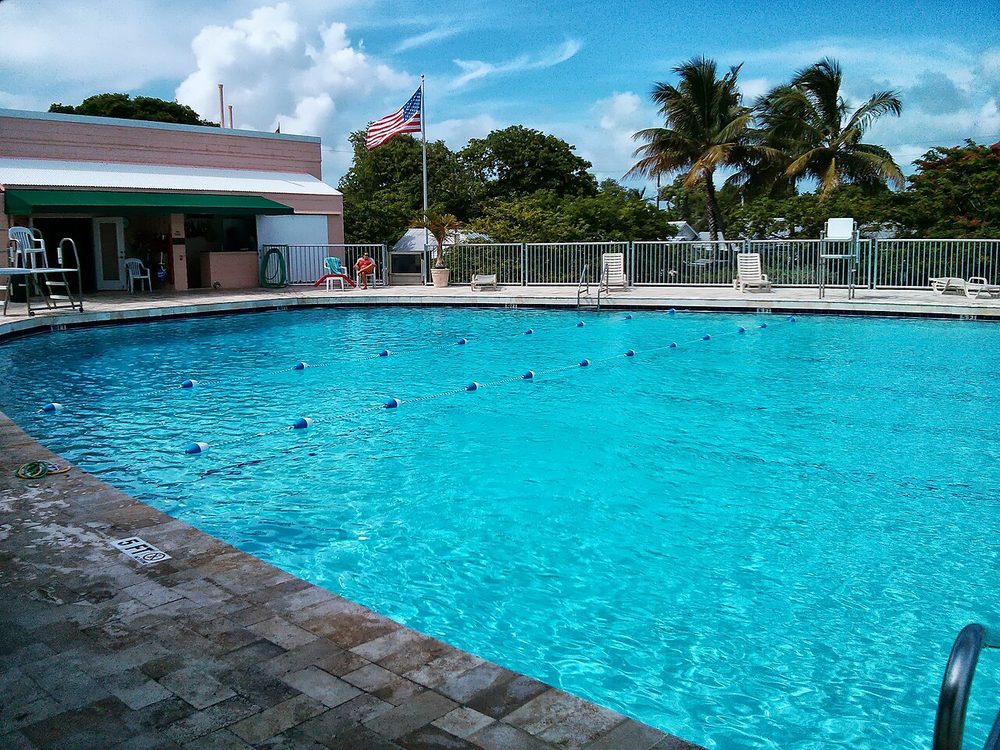
Pool decks take more punishment than almost any other surface on a South Florida lot. They sit in full sun, get splashed with chlorinated or salt water every day, stay damp under screen enclosures, and sit on sandy soil that settles. So it’s no surprise that “pool deck in disrepair” shows up in violation letters, along with the opposite problem: a homeowner who refreshed the deck in a color or material the community never approved.
This page covers the deck surface itself. If your notice is about the screen enclosure, see our pool cage violation guide. If it’s about the water, read the green pool guide. If it’s about fencing or alarms around the pool, the pool safety barrier guide is the one you want.
Your Deck or the Community’s?
“HOA pool deck” searches come from two different people: a homeowner holding a violation letter about the deck behind the house, and an owner or board member looking at the community pool. The rules are different, so sort yourself first.
| Pool deck on your lot | Community / clubhouse pool deck | |
|---|---|---|
| Who maintains it | Usually the owner, if the declaration says so | Usually the association, if the declaration says so |
| What decides | The recorded declaration and plat, not how the deck looks or who uses it most | |
| Key statutes | §720.305 (notice, hearing, fines), §720.3035 (architectural review) | §720.303 (records, budgets, reserves), §720.3055 (contracts and bids) |
| What to do next | Sort the notice below: maintenance or modification | Who pays, bids, and records |
Not sure which side of the line your deck is on? The “whose surface is it” steps in our HOA surfacing guide show how to read the maintenance article, compare the plat with your survey, and ask the manager in writing. If the notice is about a raised wood or composite deck rather than the pool surround, see our deck violation guide. Notices about pumps and heaters are covered in the pool equipment guide.
What Pool Deck Notices Usually Cite
- Cracks and trip edges. Cracked concrete, a heaved slab edge, or a gap opening up between the deck and the pool coping.
- Sunken or loose pavers. Pavers that have settled, rocked loose, or lost joint sand, often near downspouts or where the deck meets the lawn.
- Peeling or flaking coating. Acrylic spray-texture or painted decks where the top coat is coming off in patches.
- Algae, mildew, and rust staining. Black or green growth in the texture, orange marks from furniture feet or fertilizer.
- Color that doesn’t match. A deck recoated in a color outside the community’s palette, or patched in a visibly different shade.
- Unapproved material change. Pavers or tile laid over an old concrete deck, or a deck converted to travertine, without an ARC application.
- Expanded footprint. Extra deck poured into the lawn, toward the property line, or out past the cage.
Florida law requires the written notice to describe the alleged violation and, if applicable, the specific action required to cure it. If yours just says “pool deck,” email the manager and ask exactly what condition or change is cited and what the board would accept as the cure. That answer decides everything below.
Maintenance or Modification? Sorting Your Notice
Most declarations draw a line between keeping what you have in good repair and changing the lot. That line matters because the cure, the paperwork and the timeline are different on each side of it.
| What the letter describes | Usually treated as | Typical way to cure |
|---|---|---|
| Cracks, loose pavers, peeling coating, stains | Maintenance | Repair or clean in the same material and color |
| New color outside the palette | Modification | After-the-fact ARC application, or recoat in an approved color |
| Pavers, tile or stone over the old deck | Modification (often a permit item too) | ARC application with permit, or adjust to the standards |
| Larger deck footprint | Modification plus possible setback issue | Application, cut back, or remove and restore sod |
Fla. Stat. §720.3035 says an association’s authority to review and approve plans for structures and improvements on a parcel extends only to what the declaration provides or can reasonably be inferred from it. So read your declaration’s architectural section and any published standards for pool areas, hardscape colors and materials. If the standards say nothing about pool decks and only govern what’s visible from the street, that’s a legitimate question to raise. Our architectural review violation guide explains how that argument usually plays out.
The same paragraph, §720.3035(1)(a), says the association “must reasonably and equitably apply and enforce” its architectural standards on all parcel owners. And if you file an after-the-fact application and the committee turns it down, §720.3035(4)(a) requires written notice “stating with specificity the rule or covenant” relied on and “the specific aspect or part of the proposed improvement that does not conform.” That tells you exactly what to change. Our ARC denial guide covers what to do with that letter.
Fixing a Deck That’s Simply Worn Out
When the notice is about condition, the goal is to make the deck look like the community standard again, in the same material and color, without turning a repair into a redesign that needs its own approval. The right repair depends on what the deck is made of.
Sprayed acrylic or textured concrete
These finishes are a thin decorative layer over a concrete slab. Small cracks can usually be routed, filled and blended into the texture, then the whole deck recoated so the patch doesn’t show. If the coating is peeling across large areas, contractors generally pressure wash, remove loose material, repair the slab and apply a new coat. Ask for the exact product and color name in writing and match it to what the community already approved; a “close enough” color is how a maintenance fix becomes a second violation.
Pavers
Sunken or rocking pavers are normally lifted, the base is re-leveled and compacted, and the same pavers go back down with fresh joint sand. Salvaging and relaying the original pavers is the easiest way to keep the color match. If some are broken and the color is discontinued, take a sample to suppliers before you agree to a patchwork. Remember the permit note below: work at a pool deck isn’t covered by the County’s sand-set paver exemption.
Staining, algae and rust
Many “condition” notices are really cleaning problems. Soft washing or a surface cleaner usually clears algae from texture and paver joints, and rust marks need a rust remover rather than more pressure. Our pressure washing violation guide and rust stain guide cover methods by surface. Clean before you decide the deck needs resurfacing; it often doesn’t.
The joint between deck and coping
Where the deck meets the pool coping there is normally a flexible sealant joint. When that sealant dries out and opens up, water gets under the deck and the edge can crack or lift. Replacing the joint sealant is a common, modest fix that pool contractors handle. If the coping itself is loose or cracked, that’s pool structure work, so get a pool contractor to look at it rather than a deck painter.
Got a pool deck notice?
Tell us what the letter cites and your city.
When the Problem Is a Change You Already Made
If you or a previous owner recoated, re-colored or overlaid the deck without an application, you generally have three options. Which one makes sense depends on how far the work is from the standards and how much it cost.
- Apply after the fact.Ask the manager in writing whether the ARC will consider a retroactive application, and whether the hearing can be paused while it’s reviewed. Include photos, the product and color name, a site sketch showing the deck footprint, and the permit if one was pulled.
- Bring it into the standards.If the material is acceptable but the color isn’t, a recoat in an approved color may be all the board needs. If a paver overlay is the issue, ask whether a different paver from the approved list would be accepted instead of tearing everything out.
- Remove and restore. For a footprint that crosses a setback or eats into required landscaping, cutting back the deck and restoring sod may be the only cure. Our setback violation guide explains how HOA placement rules and municipal zoning setbacks overlap.
If you bought the house with the deck already changed, say so. Inherited modifications raise their own questions about notice and timing; see our guide to violations inherited from a previous owner.
The Permit Side: Pool Decks Aren’t the Exempt Kind of Paver Job
HOA approval and a building permit are separate, and you may need both. Having one doesn’t give you the other. But since the 2026 amendment to §720.3035(1)(c), an association or its architectural committee “may not require a building permit to be issued by a governmental authority to a parcel owner as a prerequisite for review.” So the HOA can’t refuse to look at your application just because the permit hasn’t been issued yet.
Palm Beach County’s Building Division publishes a list of items that don’t require a permit under Section 105 of the County’s amendments to the Florida Building Code. Two entries matter here:
- Painting is on the no-permit list. A straightforward recoat of an existing deck surface is usually in this territory, though your contractor should confirm for the specific product and scope.
- Sand-set pavers on one- and two-family lots are exempt only when they are not a pool or spa deck and are not within five feet of a pool. So paver work at the pool falls outside the exemption.
- Slabs are listed under site-plan-review-only items for one- and two-family dwellings, but not when they are located within five feet of a pool.
The County notes that the list is a concise guide and that the law controls if there’s a conflict, so treat it as the starting point and confirm with the Building Division. If you’re inside a city with its own building department (Boca Raton, Wellington, Jupiter, Delray Beach and others), its rules apply instead. Pool deck work can also affect barrier and drainage requirements, which is another reason to let a licensed contractor handle the permit.
Your Timeline Under §720.305
Florida’s HOA statute gives you more room than a blunt violation letter suggests. Under Fla. Stat. §720.305(2):
- A fine or suspension can’t be imposed unless the board first gives at least 14 days’ written notice of your right to a hearing.
- The hearing must be held within 90 days after the notice, before a committee of at least three members who aren’t officers, directors or employees (or their close relatives).
- If the violation is cured before the hearing, or in the manner specified in the notice, a fine or suspension may not be imposed.
- Unless your documents say otherwise, fines are capped at $100 per violation and $1,000 in the aggregate, and a fine under $1,000 can’t become a lien.
A permitted paver relay or a full recoat can take longer than the time before your hearing, especially if you need ARC approval first. Ask for a written extension as soon as you know the job won’t finish in time, and attach the signed contract or permit application to show you’re moving. Our guide to curing before the hearing walks through how to document that.
Getting Quotes That Will Satisfy the Committee
A vague quote (“resurface deck”) won’t help you at the ARC or the hearing. Ask contractors to put these in writing:
- The deck area and exactly which sections are being repaired, recoated or relaid.
- The product and color name, plus a sample you can submit if a color change is involved.
- Crack repair and coping-joint sealant scope, so the fix doesn’t reopen in a few months.
- Whether a permit is needed, who pulls it, and the expected final inspection.
- A start date and duration you can hand the manager with your extension request.
- Cleanup and sod or landscape restoration if the footprint changes.
You choose the contractor. Fla. Stat. §720.3075(3)(e) says HOA documents may not preclude you “from inviting, hiring, or allowing entry to a contractor or worker on the owner’s parcel solely because the contractor or worker is not on a preferred vendor list of the association.” The 2026 text of (3)(e) also bars documents from precluding a worker solely for lacking a professional or occupational license, but that only limits the HOA. The building department’s licensing and permit requirements still apply to permitted deck work.
If It’s the Community Pool Deck: Who Pays, Bids, and What Owners Can See
When the declaration puts the pool area on the association, resurfacing it isn’t a violation question at all. It’s a spending decision, and Florida law puts a few guardrails on it.
Who pays
The money comes from the operating budget, an established reserve account, or a special assessment. Our HOA surfacing guide covers how reserves and assessment notices work for association surfaces, and the guide to special assessments vs. violation fines explains why an assessment for common-area work is not a fine against you.
When bids are required
Under Fla. Stat. §720.3055(1), association contracts for materials, equipment or services must be in writing. If a contract “requires payment by the association that exceeds 10 percent of the total annual budget of the association, including reserves, the association must obtain competitive bids.” The statute also says nothing in it requires the association to accept the lowest bid. The 10 percent is measured against your own association’s budget, so whether a given resurfacing job crosses the line depends on that budget.
Subsection (2) lists the exceptions, in plain terms:
- Contracts with employees, and for attorney, accountant, architect, community association manager, engineering and landscape architect services, are outside the section.
- Nothing in the section limits the association’s ability to get needed products and services in an emergency.
- It doesn’t apply if the contractor is the only source of supply within the county serving the association.
- If the declaration or bylaws have their own bidding rules that are not less stringent than the statute, the association may follow those instead.
What owners can ask to see
Under §720.303(4), the association’s official records include copies of plans, specifications, permits and warranties for improvements on common areas it must maintain, and a current copy of all contracts it is a party to. Bids received for work to be performed are official records and must be kept for one year. Records must be made available within 10 business days after the board receives an owner’s written request. Separately, an association with 100 or more parcels must post on its website or app a list of current executory contracts and, after bidding has closed, a list of bids received within the past year (§720.303(4)(b)1.e.). Our records request guide has a sample letter. Ask for the budget line, the bids and the proposed contract in writing before the vote.
Pool rules are a separate regulator
Florida’s public pool law treats pools serving subdivisions as public pools (§514.011(2)). Under §514.0115(3), pools serving homeowners’ associations with no more than 32 units or parcels, and not operated as public lodging, are exempt from supervision under that chapter except for water quality and §514.0315. Before deck work starts, the board should confirm with the county health department and the building department what approvals the job needs.
Condominium pool decks run under Chapter 718, not 720, and the rules differ. See condo vs. HOA violations.
Step-by-Step: Closing a Pool Deck Violation
- Read the notice and write down the deadline, the hearing date and the cure it describes.
- Decide whether it’s maintenance or modification using the table above.
- Pull your declaration and pool area or hardscape standards, including the approved color list.
- Email the manager to confirm the cure and, for modifications, whether an after-the-fact application is allowed.
- Clean first if staining is part of the complaint, then reassess whether repair is still needed.
- Get written quotes with product, color, scope and permit spelled out.
- Request an extension in writing if the work won’t be done before the hearing.
- Document the cure with dated before-and-after photos, the invoice and any permit final, and send them to the manager before the hearing.
Not sure how to word the email? The HOA response generator drafts one from your notice.
Mistakes That Keep the File Open
- Recoating a condition violation in a new color you like better, which creates a modification violation.
- Patching cracks without recoating, leaving obvious scars the committee still reads as disrepair.
- Laying pavers over the deck without a permit because “pavers don’t need one.” At the pool, they usually do.
- Ignoring the coping joint, so the same crack comes back before the reinspection.
- Missing the deadline without asking for an extension in writing.
- Finishing the job and never sending proof. If the committee doesn’t see the cure, it may treat the violation as open.
Frequently Asked Questions
Can my HOA cite me for a pool deck it can only see from a neighbor’s yard?
It depends on what your declaration says. Many Palm Beach County declarations require owners to keep every part of the lot, including improvements in the rear yard, in good repair, and some architectural standards cover any exterior surface change no matter where it is. Others limit review to what is visible from the street or common areas. Read the maintenance and architectural control sections, and if the notice relies on a visibility standard, ask the manager in writing which rule is being applied.
Do I need HOA approval to resurface my pool deck?
If you are repairing the existing surface in the same material and color, many communities treat that as maintenance. If you are changing the material (for example, from a spray texture to pavers or travertine), the color, or the footprint, most declarations treat it as an exterior modification that needs architectural review first. Under Fla. Stat. §720.3035, the association’s review authority extends to what the declaration provides or can reasonably be inferred from it, so the declaration and the published standards decide.
Does Palm Beach County require a permit for pool deck pavers?
Palm Beach County’s Building Division list of items not requiring a permit exempts sand-set pavers on one- and two-family lots only when they are not a pool or spa deck and not within five feet of a pool. A slab is also excluded from the site-plan-only category when it is within five feet of a pool. In practice that means paver or slab work at the pool usually needs a permit in unincorporated areas. Painting is on the no-permit list. Cities such as Boca Raton, Wellington and Jupiter run their own building departments, so confirm with yours.
Will I be fined if I fix the deck before the hearing?
Fla. Stat. §720.305(2)(e) says that if a violation has been cured before the hearing, or in the manner specified in the written notice, a fine or suspension may not be imposed. The board must give at least 14 days’ written notice of your right to a hearing, and the hearing must be held within 90 days after the notice is issued, before a committee of at least three members who are not officers, directors or employees.
How much can my HOA fine me for a pool deck violation?
Unless your governing documents provide otherwise, §720.305(2) caps a fine at $100 per violation and $1,000 in the aggregate for a continuing violation, and says a fine of less than $1,000 may not become a lien against the parcel. Your documents can set different limits, so check them.
Can the HOA make me use its approved pool deck contractor?
No. Fla. Stat. §720.3075(3)(e) says HOA documents may not preclude an owner “from inviting, hiring, or allowing entry to a contractor or worker on the owner’s parcel solely because the contractor or worker is not on a preferred vendor list of the association.” Your contractor still has to meet the building department’s licensing and permit requirements.
Can my Florida HOA make me resurface or repair my own pool deck?
Only to the extent your declaration or the published standards it authorizes say so. Fla. Stat. §720.3035(1)(a) limits architectural and appearance enforcement to what those documents specifically state or reasonably infer, and requires the association to apply them reasonably and equitably to all owners. Repairing cracks or recoating in the approved color is usually treated as maintenance; changing color, material, or footprint usually needs architectural approval first. If you cure the violation before the hearing, §720.305(2)(e) says no fine may be imposed.
Does my HOA need to see a building permit before it reviews my pool deck application?
No. Fla. Stat. §720.3035(1)(c), added in 2026 by chapter 2026-63, Laws of Florida, says an association or its architectural committee may not require a building permit to be issued as a prerequisite for reviewing an owner’s improvement. You may still need both HOA approval and a county or city permit. This is legal information, not legal advice.
Who pays to resurface the community pool deck in a Florida HOA?
If the declaration makes the association responsible for the pool area, the cost comes from the operating budget, an established reserve account, or a special assessment, not from the individual owner whose house is closest. The declaration and the recorded plat decide whose surface it is. The resurfacing contract is an official record owners can request in writing under §720.303(4).
Does a Florida HOA have to get competitive bids to resurface the community pool deck?
Sometimes. Under Fla. Stat. §720.3055(1), association contracts for materials, equipment or services must be in writing, and if a contract requires payment by the association that exceeds 10 percent of the total annual budget of the association, including reserves, the association must obtain competitive bids. It is not required to accept the lowest bid. Exceptions include emergencies, a sole source of supply in the county, and declaration or bylaw bidding rules that are not less stringent than the statute.
Need the deck fixed before the hearing?
Need to ask the manager what cure they’ll accept, or request an extension? Draft the email.
Generate My Response →Looking at the community deck?
Request the budget, the bids and the proposed contract in writing before the board votes.
How to request association records →Sources: 2026 Florida Statutes on flsenate.gov, checked November 19, 2026: §720.305(2) (fines, $100/$1,000 limits, lien threshold, 14-day notice, 90-day hearing, committee, cure before hearing); §720.3035(1)(a), (1)(c) and (4)(a) (architectural review authority, no permit prerequisite, written denial); §720.3075(3)(e) (preferred vendor list); §720.3055 (written contracts, competitive bids, exceptions); §720.303(4) (official records, 10 business days, website posting); §514.011(2) and §514.0115(3) (public pools, 32-parcel HOA exemption); Palm Beach County Planning, Zoning & Building, Building Division, “Items Not Requiring a Permit” (Section 105 County amendments; painting; sand-set pavers excluding pool/spa decks and within five feet of a pool; site plan review slabs excluding within five feet of a pool), re-checked November 19, 2026. This page summarizes public information. It is legal information, not legal or contracting advice. Your declaration, architectural standards, and local building department control.